


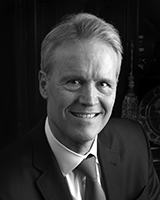
David B. Hellmann,
MD, MACP
What’s the secret to staying young — or more accurately, staying intellectually young? The more birthdays I celebrate, the more I find myself returning to this question. I’ve concluded there are three essential keys to maintaining a youthful spirit, and I believe you will find vibrant examples of all three in this issue of Breakthrough.
CURIOSITY is the first key. It is the restless, inquisitive drive you’ll find in Elliot Fishman, the new Sarah Miller Coulson CIM Scholar, who is leveraging artificial intelligence to improve the early detection of pancreatic cancer when it is most treatable. You will see it in Roy Ziegelstein, our 2026 Miller Lecturer, who coined the term “Personomics” — the vital science of knowing the patient as a unique individual. And you’ll find it in Michelle Sharp, the Mary Gallo CIM Scholar and assistant director of CIM, whose seminars have brought polymaths like Alan Alda and Yo-Yo Ma into our orbit.
ADAPTABILITY — specifically the dedication to learning new skills — is the second force for maintaining vitality. Cindy Rand, a Mary Gallo CIM Scholar, and Nadia Hansel, director of the Department of Medicine and Lavinia Currier CIM Scholar, recognized that our CIM Scholars program could reach even greater heights by fostering a formal community. Thanks to their vision, we have launched the Academy for CIM Next Generation Scholars under the leadership of Bloomberg Distinguished Professor Theodore (Jack) Iwashyna, ensuring that mentorship remains at the heart of our mission.
What is the third secret?
LUCK. That is a quality CIM has in abundance. We are immensely lucky to work alongside such brilliant colleagues, and we are most fortunate to have the steadfast support of our readers and donors. Thank you for being part of our “fountain of youth.”
David B. Hellmann, M.D., M.A.C.P.
Aliki Perroti Professor of Medicine
Don Willett May 4th, 2026
Posted In:
David B. Hellmann,
MD, MACP
What’s the secret to staying young — or more accurately, staying intellectually young? The more birthdays I celebrate, the more I find myself returning to this question. I’ve concluded there are three essential keys to maintaining a youthful spirit, and I believe you will find vibrant examples of all three in this issue of Breakthrough.
CURIOSITY is the first key. It is the restless, inquisitive drive you’ll find in Elliot Fishman, the new Sarah Miller Coulson CIM Scholar, who is leveraging artificial intelligence to improve the early detection of pancreatic cancer when it is most treatable. You will see it in Roy Ziegelstein, our 2026 Miller Lecturer, who coined the term “Personomics” — the vital science of knowing the patient as a unique individual. And you’ll find it in Michelle Sharp, the Mary Gallo CIM Scholar and assistant director of CIM, whose seminars have brought polymaths like Alan Alda and Yo-Yo Ma into our orbit.
ADAPTABILITY — specifically the dedication to learning new skills — is the second force for maintaining vitality. Cindy Rand, a Mary Gallo CIM Scholar, and Nadia Hansel, director of the Department of Medicine and Lavinia Currier CIM Scholar, recognized that our CIM Scholars program could reach even greater heights by fostering a formal community. Thanks to their vision, we have launched the Academy for CIM Next Generation Scholars under the leadership of Bloomberg Distinguished Professor Theodore (Jack) Iwashyna, ensuring that mentorship remains at the heart of our mission.
What is the third secret?
LUCK. That is a quality CIM has in abundance. We are immensely lucky to work alongside such brilliant colleagues, and we are most fortunate to have the steadfast support of our readers and donors. Thank you for being part of our “fountain of youth.”
David B. Hellmann, M.D., M.A.C.P.
Aliki Perroti Professor of Medicine
Don Willett May 4th, 2026
Posted In:
 For the 15 Johns Hopkins faculty members who have recently been selected as CIM Next Generation Scholars, the news just keeps getting better. The award, which brings up to $300,000 in funding over three years, has enabled them to continue their innovative work — threatened by federal funding cuts — aimed at advancing medicine as a public trust.
Now, with the launch of the new Academy for CIM Next Generation Scholars, these top clinician-researchers will find valuable mentorship and community, acquire valuable communication skills, and explore new models for philanthropic support — all aimed at equipping them to succeed amid an ever-evolving funding landscape in academic medicine.
With six to 10 new recipients expected to be added to the ranks of the Scholars every year, the Academy is quickly becoming a vibrant force, equipped to forge lasting advances for patients at Johns Hopkins and beyond, says Theodore “Jack” Iwashyna, a critical care physician and health services researcher who has been tapped to lead the program.
Iwashyna joined Johns Hopkins in 2022 as a Bloomberg Distinguished Professor (see sidebar). A central reason for his recruitment was his ability to contribute to Johns Hopkins recruitment and training of the absolute best in clinician-scientists. Thus his aim and CIM’s aim aligned: to prepare cadres of leaders to enact transformational change in health care systems in the U.S. and around the world.
“Our goal with the Academy is to work with the best and brightest of Johns Hopkins Medicine — clinician-researchers who are committed to humanizing medicine and advancing medicine as a public trust — to give them the support and knowledge they need to succeed in an academic world that’s been turned upside down,” he says.
“While there have been dramatic changes in the government-university partnerships — partnerships that have made American science and medicine the best in the world — the core values remain irreplaceable,” he says. “The world still needs Hopkins to invent new futures of medicine. The Academy is our laboratory to figure out how to ensure the geniuses of these great clinician-scientists fully flower.”
The Academy is one part. Next Generation Scholars are also all paired with senior Hopkins faculty members who will serve as valued mentors, sharing their hard-earned wisdom and opening doors to collaborators, leadership opportunities and potential new funding sources, notes Cynthia Rand, senior associate dean for faculty at the school of medicine and Mary Gallo CIM Scholar, who is acting as an adviser to Iwashyna.
“The world still needs Hopkins to invent new futures of medicine. The Academy is our laboratory to figure out how to ensure the geniuses of these great clinician-scientists fully flower.” – Theodore “Jack” Iwashyna
Key to these mentoring relationships will be helping young faculty to effectively communicate their research and its impact to a wide variety of audiences, including potential donors.
“Currently during the training of physician-scientists, they may learn to write an NIH grant or a scholarly paper aimed at other scientists, but there’s no point when they learn how to communicate their work to the world, writ large,” says Rand. “This kind of communication is crucial now more than ever.”
Iwashyna envisions a “bi-directional” flow of ideas and communication between the CIM Next Generation Scholars and interested donors, as they find areas of shared interest and identify ways that philanthropy can propel medical innovations forward for the greater good.
“We have always partnered with funding agencies,” he says. “We have learned over the last years how much better science can be when it is done in partnership with patients and families. In these new times, there are new opportunities and needs to build partnership between philanthropists and physicians much earlier in the physicians’ careers than has been traditional. We can invest in the future together.”
Through regular meetings and seminars, he also expects the Scholars to “build valued lateral networks” through which they become resources to one another in advancing their goals. “The community within the Scholars, and among the Scholars and Johns Hopkins broadly, is a unique resource,” he says. While the Scholars hail from a wide variety of disciplines and specialties — from lab-based science to addiction medicine to cardiology to infectious disease — all share a commitment to equity and justice in medicine, Iwashyna notes.
At a time when rapid advances in technology and other pressures risk dehumanizing health care for patients and their clinicians, says Rand, the Academy for CIM Next Generation Scholars aims “to keep the heart and soul in medicine, finding creative ways for young faculty to ensure biomedical science continues moving forward.”
Don Willett May 4th, 2026
Posted In:
 In the years that Martha Abshire Saylor worked as a critical care nurse, she saw firsthand what can unfold when patients without advance care plans undergo procedures they may never have wanted.
“The lack of a documented advance care plan can result in painful and life-extending medical interventions that often don’t ensure quality of life or even that a patient leaves the hospital,” says Abshire Saylor, the Mary Ousley CIM Scholar, who specializes in advanced heart failure and palliative care. As an example, she remembers performing CPR — which can cause significant painful injury — on a patient of advanced age in multiple organ failure.
“Currently, recommendations in advanced care planning in those with cognitive impairment are based on clinical expertise without the evidence from actual conversations with patients and families.” – Abshire Saylor
Such experiences have inspired Abshire Saylor in her clinical research efforts to make advanced care planning more widely accessible and effective in representing a patient’s desires and values, particularly as patients age and experience cognitive decline.
“Currently, recommendations in advanced care planning in those with cognitive impairment are based on clinical expertise without the evidence from actual conversations with patients and families,” she notes.
To address this shortcoming, Abshire Saylor led a recent study — published in Alzheimer’s & Dementia — in adults age 80 and older, which analyzed transcripts of advanced care planning discussions (see sidebar). These discussions included the patients’ care partners (typically family members) and ran for about 35 minutes. Of the 88 conversations analyzed, 15 participants had normal cognition, 13 had mild cognitive impairment and 60 had severe impairment (dementia).
“Being family-centered and inclusive of family members in health care makes advanced care planning conversations so much easier, particularly at the end of life — for patients, caregivers and clinicians.” – Abshire Saylor
In analyzing the conversations, Abshire Saylor and her team identified key themes that can be used to inform best practice. One is that though cognitive impairment can inhibit a patient’s participation in these discussions, individuals with dementia are still able to contribute. A second key insight: Care partners play a critical role in supporting advanced care planning across the spectrum of cognitive impairment.
For Abshire Saylor, whose clinical research has long emphasized the importance of supporting family caregivers of patients with serious illness, this second finding came as no surprise. “Being family-centered and inclusive of family members in health care makes advanced care planning conversations so much easier, particularly at the end of life — for patients, caregivers and clinicians,” she says. “We found that caregivers wanted to honor their loved one’s wishes if they were known.”
Mary Catherine Beach, co-director of the Center for Humanizing Medicine and a Mary Gallo CIM Scholar, praises Abshire Saylor’s approach and notes that her clinical research is central to the mission of the CHM.
“What is so beautiful about this work is that Martha is able to balance respect for autonomy with the lived reality of evolving cognitive impairment,” says Beach. “In doing so, she shows how clinicians can work collaboratively with patients and their families to preserve as much capacity as possible while also respecting the patient and family more holistically.”
“What is so beautiful about this work is that Martha is able to balance respect for autonomy with the lived reality of evolving cognitive impairment.” – Mary Catherine Beach
While discussions around advanced care planning involve many procedural questions — If your heart stops, do you want CPR? Defibrillation? Would you ever want to receive a feeding tube? — Abshire Saylor believes the most crucial decisions center on naming a surrogate decisionmaker in the event the patient can’t communicate their wishes.
Moreover, “It’s crucial for caregivers to understand the level of permission they’ve been given,” she explains. “On one end are patients who say: ‘I feel strongly about what I want and I want you to execute that.’ On the other end of the spectrum are people who say, ‘I understand that my medical situation may change in a way that I can’t imagine; I trust that you’ll do your best and I give you permission to do what you think is right by me.’”
This project is just one of several that Abshire Saylor has been pursuing and she is pleased to note that Johns Hopkins Community Physicians has committed to expanding services in advanced care planning throughout the health system.
CHM Co-Director Scott Wright, Mary Gallo CIM Scholar and holder of the Anne Gaines and G. Thomas Miller Professorship, sees such efforts as being important and timely.
“This study is a wonderful reminder for clinicians to partner with all patients — and caregivers,” says Wright, who is also director of CIM’s Miller Coulson Academy of Clinical Excellence.
“While this is a best practice for every clinical decision, it is especially critical for advanced care planning. Although there can be pressures in contemporary medicine that may conflict with patiently listening, this paper highlights the value of taking the time to hear and understand the perspectives of older adults with cognitive impairments.”
Don Willett May 4th, 2026
Posted In:
As the organizer of the 2025–2026 CIM Seminars, pulmonologist Michelle Sharp, a Mary and David Gallo CIM Scholar and Elena and Everardo Goyanes CIM Scholar, has drawn an inspiring array of speakers who have shared their insights from both inside Johns Hopkins and from much farther afield.
In January, for example, audience members heard from actor Alan Alda and physician Karl VanDevender, his friend and collaborator, in a seminar on “Speaking Science, Hearing Humanity.” And in early March, internationally renowned cellist Yo-Yo Ma spoke movingly about the healing power of music.
Sharp has served as the interviewer in this year’s seminars, which unfold about twice a month over Zoom for an eager audience of patients, CIM donors, and current and former Johns Hopkins faculty members. Among the questions she asks is one that gets to the very heart of CIM’s mission: What does medicine as a public trust mean to you personally?
In the excerpts that follow, we offer a sampling of responses to this question from a variety of speakers who led seminars this academic year.
“I was always struck with the things we ask patients to share with us — the precious information about themselves and their lives. And so obviously there’s that trust. And then there’s the trust where they are relying on us to use our knowledge, our experience and our wisdom on their behalf, and to always look after their interest. Those are the top two for me.”
– William G. Kaelin Jr., 2019 Medicine Nobel Prize-winner and former Johns Hopkins Osler Medical resident, now on faculty at Harvard Medical School and the Dana-Farber Cancer Institute
“I’m intrigued by the relationship between the language of public trust and public good. I think they’re so deeply related, they could be used interchangeably. A public good is something that advances the collective well-being of society, as well as the well-being of individuals that comprise society. I can’t imagine another social institution that more qualifies for the language of a public good than medicine, healthcare and public health. All constitute for me a public good, in the same way a free press does, a functioning educational system does, an independent judiciary does.
“Without these institutions we would have a very diminished collective experience, and as individuals, we would not flourish.”
– Ruth Faden, founder, Johns Hopkins Berman Institute of Bioethics
“If you look in a dictionary, it will say that public trust means you have the public good at your heart. That you are there to serve your local community. When you work in health care and particularly in my role at The Johns Hopkins Hospital, being the anchor institution for your local community is really, really important.
“It’s not just being here behind walls and delivering care when people come to us. It’s being in the community, helping folks stay healthy. And that takes on a lot of different looks. That’s chronic disease prevention, sure. But I think it goes beyond that. It’s [considering] the social determinants of health. What are we doing to help housing? What are we doing for jobs?
“I can go into a lot of different programs we have here — from participating with city hospitals and providing shelter homes with wraparound services to local residents who are experiencing homelessness [to] what we’re doing in hiring [such as removing questions about criminal history from initial job applications to foster opportunities for individuals with criminal records]. I do think we take that role seriously.”
– Redonda Miller, president, The Johns Hopkins Hospitals
“Everything is important for public trust, but one of the most important components of delivering and improving health is the capability and the wellbeing and the health of the physician workforce that’s delivering that care. I think that’s part of the public good, of the public trust.”
– Sanjay Desai, formerly chief medical officer for the American Medical Association; recently named Vice Dean for Education, Johns Hopkins University School of Medicine
“Over time, I’ve really come to appreciate that there are so many ways that we can impact health, and I think a lot about lung health. So beyond seeing patients in the clinic, which is a joy and a privilege, I also try to think about how I can be an ambassador for improving health — whether it’s at a school, advocating for having buses not idle [out] front, or being a champion for air quality. And so thinking about population health in addition to the health of the individual is something that I’ve tried to lean into more over time, because I think we can broaden our impact in that way.”
– Meredith McCormack, director, Johns Hopkins Division of Pulmonary and Critical Care Medicine
Don Willett May 5th, 2026
Posted In: